- Dried catnip, 1 tbsp (about 2 g): $0.15 to $0.30
- Polyester fiberfill, 0.5 cup: $0.10 to $0.25
- Crew sock or fabric scrap, 1 sock or one 6 x 6 in. square: $0 to $0.75
- Washable fabric glue, 1 tsp: $0.05 to $0.10
- Felt sheet (9 x 12 in.), 0.5 sheet: $0.30
- Scissors: already owned
Prices are US estimates and vary by retailer. Safety note: Use only washable, non-toxic fabric glue, and seal fiberfill fully inside the toy, because loose fill is a swallowing hazard.
No sewing catnip toys DIY takes 10 to 15 minutes and four materials: dried catnip, a fabric scrap or sock, polyester fiberfill, and either fabric glue or a knot. The five patterns below seal catnip inside using knots, glue, and folds, so no needle or thread is involved. Each toy costs between $0.25 and $1.50.
Store-bought catnip toys cost $4 to $9 each and lose their scent within 2 weeks. This cat toy tutorial gives you exact measurements, safe materials, and a lineup of cat toy patterns that covers kickers, pouches, and crinkle toys. You finish with five homemade catnip toys, and these DIY catnip toys cost less than a single store-bought one.
Why Do Cats React to Catnip Toys?
Nepetalactone triggers the response, and the compound sits in the leaves and stems of catnip (Nepeta cataria). Bol et al. (2017, BMC Veterinary Research) tested 100 domestic cats, and 68% responded to catnip. Uenoyama et al. (2021, Science Advances) trace the effect to the opioid pathway.
The iridoid response lasts about 10 minutes, and a refractory period of roughly 30 minutes or longer follows. Rubbing, rolling, and kicking dominate the response, and those hunting-linked behaviors feed prey drive. Catnip toy ideas built for grabbing and kicking give toys for cats a physical outlet for that hunting instinct.
| Measure | Value |
| Response duration | About 10 minutes |
| Refractory period | Roughly 30 minutes or longer |
| Responder rate | 68% of 100 cats (Bol et al., 2017) |
Browse more options in Cat enrichment ideas for indoor cats.
What Materials Do You Need for No-Sew Cat Toys?
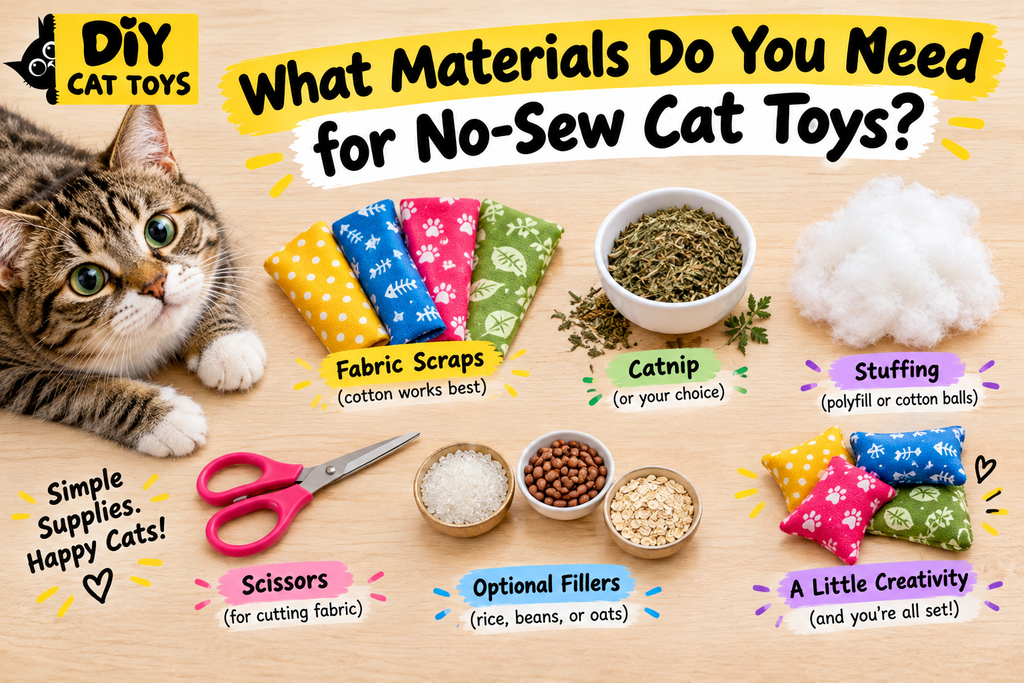
Dried catnip goes in at 1 tbsp (about 2 g) per toy. Buy dried catnip from a pet store or garden retailer; the ASPCA lists catnip as non-toxic to cats. Prices vary by retailer, so treat the table below as a US estimate.
| Material | Quantity per toy | Est. cost (USD) | Safety | Best use |
| Dried catnip | 1 tbsp (about 2 g) | $0.15 to $0.30 | Non-toxic per ASPCA | Scent core in all 5 patterns |
| Polyester fiberfill | 0.5 cup | $0.10 to $0.25 | Safe sealed inside; swallowing hazard if exposed | Sock Kicker |
| Crew sock or fabric scrap | 1 sock or one 6 x 6 in. square | $0 to $0.75 | Wash first; trim loose threads | Kickers and bundles |
| Washable fabric glue | 1 tsp | $0.05 to $0.10 | Non-toxic when labeled washable | Felt Fish seam |
| Felt sheet (9 x 12 in.) | 0.5 sheet | $0.30 | Trim loose fibers | Felt Fish |
| Hot glue | Not needed | Varies by retailer | Burns skin, cures hard | Skip for cat toys |
What to put inside cat toys: polyester fiberfill is the standard cat toy stuffing, and clean cotton ball padding or fabric scraps replace it at $0. Old socks and cotton T-shirts become upcycled cat toys with the same pattern. Reusing upcycled household items keeps the no-sew cat toys under $1.50 each.
Fabric glue beats hot glue for this job: hot glue burns skin and cures hard, while washable fabric glue stays flexible. Check the label for cure time, because brands vary.
Safety note: Avoid super glue and solvent-based adhesives, which are toxic to cats. Skip loose beads and buttons, which detach and cause choking.
How to Make 5 No-Sew Catnip Toys
These easy no-sew cat toys with catnip replace thread with a knot, a glue line, or a fold, and the DIY cat toys no sew approach needs only scissors. Every pattern lists exact sizes, and every step that involves a cutting tool, adhesive, or loose end carries a safety note. Finished toys double as interactive play for cats when you toss or dangle them, and all five are homemade cat toys easy enough for a first project.
Pattern 1: Catnip Sock Kicker (5 Minutes)
This catnip sock toy is the fastest of the cat toys from socks, and it is the best homemade cat toy from old socks for kicking.
- Cut a clean crew sock so it measures 10 in. from toe to cut edge. Safety: cut away from your hands.
- Pack 0.5 cup polyester fiberfill into the toe end.
- Push 1 tbsp dried catnip into the center of the fill.
- Twist the open end closed and tie an overhand knot against the filling. Pull it tight.
- Trim the excess fabric beyond the knot to 0.5 in.
Bunny-kicking behavior, where the cat clutches the toy with its front paws and rakes it with the hind legs, is the reason this toy is long and firm. In practice, a 10 in. length suits cats over 8 lb.
Pattern 2: Glued Felt Catnip Fish (15 Minutes Plus Cure Time)
These felt catnip toys use diy catnip toys with felt scraps, and the no-sew cat toys using fabric glue method seals the seam without stitching.
- Cut two identical 4 x 6 in. felt fish shapes. Safety: keep fingers clear of the blade.
- Spread a 0.25 in. border of washable fabric glue around one shape, using 1 tsp total. Leave a 1 in. gap at the tail.
- Press the second shape on top and align the edges.
- Drop 1 tsp catnip through the gap, then glue the gap shut and press the edges flat.
- Let the fish cure for about 24 hours before play; check the glue label for cure time.
Safety note: Keep the fish away from your cat until the glue is fully dry.
Pattern 3: Crinkle Cardboard Tube (2 Minutes)
This is the cheapest of the cheap homemade cat toys.
- Take one empty toilet paper roll and remove any tape or stickers.
- Pinch one end flat and crimp the fold with your fingers.
- Add 1 tsp catnip through the open end.
- Fold the second end flat and crimp it.
- Press the tube once to confirm both ends hold.
Discard the tube when the cardboard tears or the ends open.
Pattern 4: Tied T-Shirt Catnip Bundle (6 Minutes)
Cat toys from fabric need no pattern here: any catnip toy with scraps from an old cotton T-shirt works.
- Cut a 12 x 12 in. square from a clean cotton T-shirt. Safety: cut on a flat surface.
- Cut a 1 x 10 in. strip from the same shirt.
- Place 1 tbsp catnip in the center of the square.
- Gather the four corners upward into a pouch.
- Wrap the strip around the neck of the pouch, tie a double knot, and trim the tail to 0.5 in.
Pattern 5: Fleece Roll (4 Minutes)
This catnip toy pattern doubles as a no sew cat kicker.
- Cut a 6 x 10 in. rectangle of fleece, plus two 1 x 10 in. fleece strips. Safety: cut on a flat surface.
- Lay the rectangle flat and spread 1 tsp catnip in a line across the width.
- Roll the fleece tight from one long edge.
- Tie a fleece strip around each end of the roll in a double knot.
- Trim every tail to 0.5 in.
Do Catnip Toys Work for Every Cat? (Myths and Limits)
Myth: every cat reacts to catnip. The response is an autosomal dominant trait (Todd, 1962, Journal of Heredity), and roughly one-third of adult cats do not respond. A non-responding adult cat treats a catnip toy as plain fabric. Those cats react to silver vine and Tatarian honeysuckle instead (Bol et al., 2017); see Silver vine vs catnip.
Myth: kittens love catnip. Kittens under 8 weeks show no reaction. In practice, sensitivity appears between 3 and 6 months, so catnip toys for kittens work only from that age. For younger kittens, use kitten-safe toy materials such as plain fleece, cotton, and felt, with no catnip.
Myth: catnip is addictive. Catnip is not addictive, because the refractory period prevents overstimulation. Offer catnip toys to adult cats 2 to 3 times per week. Rotating the five patterns adds simple DIY toys for bored cats and builds bored indoor cat solutions into the weekly routine.
Are Homemade Cat Toys Safe? (Safe Cat Toys Checklist)
Choking hazards in cat toys come from small parts and loose ends, and these safe cat toys rules close each gap. The ASPCA toxic plant list confirms catnip is non-toxic to cats.
- Cut every string, ribbon, and yarn tail to 0.5 in. or shorter. Cornell Feline Health Center documents linear foreign body obstruction from strings, ribbon, and yarn.
- Use zero buttons, googly eyes, and bells, which detach and cause choking.
- Discard any toy with an open seam, exposed fiberfill, or a chewed hole.
- Wash cotton and fleece toys in cold water, then refresh old catnip toys with 1 tsp fresh catnip.
- Supervise kittens under 6 months during first use.
For more checks, read Cat-safe household items. Consult your veterinarian if your cat swallows any toy material.
Frequently Asked Questions About Homemade Catnip Toys
How do you make catnip toys without sewing?
Catnip toys without sewing use three sealing methods: a knot, fabric glue, or a fold. Add 1 tbsp of dried catnip to a sock, fabric square, or fleece strip, close it with a double knot or a glue line, and trim every tail to 0.5 in. Each build takes 10 to 15 minutes.
What do you put inside homemade cat toys?
Homemade cat toys take polyester fiberfill (0.5 cup per toy), clean cotton padding, or fabric scraps as filling. Avoid rice, beans, and foam beads, which spill out when a seam opens and create choking hazards. Seal every seam so no filling is exposed.
Are catnip toys safe for kittens?
Catnip toys are safe for kittens when built from non-toxic materials, since the ASPCA lists catnip as non-toxic to cats. Kittens under 8 weeks do not respond to catnip. Supervise play with kittens under 6 months, and use zero buttons, bells, or tails longer than 0.5 in.
How often can cats have catnip?
Adult cats can have catnip 2 to 3 sessions per week. The iridoid response lasts about 10 minutes, and a refractory period of roughly 30 minutes follows. Store catnip toys in a sealed bag between sessions to hold the scent.
How do you refresh old catnip toys?
Old catnip toys regain scent in three ways: rub the toy between your hands to release the oils, add 1 tsp of fresh dried catnip, or seal the toy in a bag for 24 hours with a pinch of dried catnip. Wash cotton and fleece toys in cold water first.
Conclusion
A no-sew catnip toy holds up when the seal is a double knot or a fully cured glue line and every tail measures 0.5 in. or less. Check each seam before every session, discard any toy with an open seam, and match each pattern to your cat: the Sock Kicker for grabbers, the Felt Fish for carriers, the Cardboard Tube for crinkle fans.
Each toy costs under $1.50, replaces a $4 to $9 store-bought toy, and gives indoor cats a hunting outlet. These catnip toy ideas turn scraps into practical bored indoor cat solutions, with five patterns to rotate through the week.
Tell us which pattern your cat destroyed first in the comments, and subscribe for the next DIY enrichment tutorial.