- 1 uncoated cardboard box, 12 x 10 x 8 in: $0 (recycled)
- 6 toilet paper rolls: $0
- 1 shoebox: $0
- 1 clean cotton sock: $0 to $1
- 2 sheets of plain, unprinted packing paper: $0
- 1 paper grocery bag, handles cut off: $0 to $0.50
- 1 cotton washcloth: $1
- 1 sanded wooden dowel, 24 in long, 3/8 in thick: $2
- 1 old cotton T-shirt: $0
- 1 tsp dried catnip (catnip variant only): about $0.25
- Safety scissors and masking tape: already owned
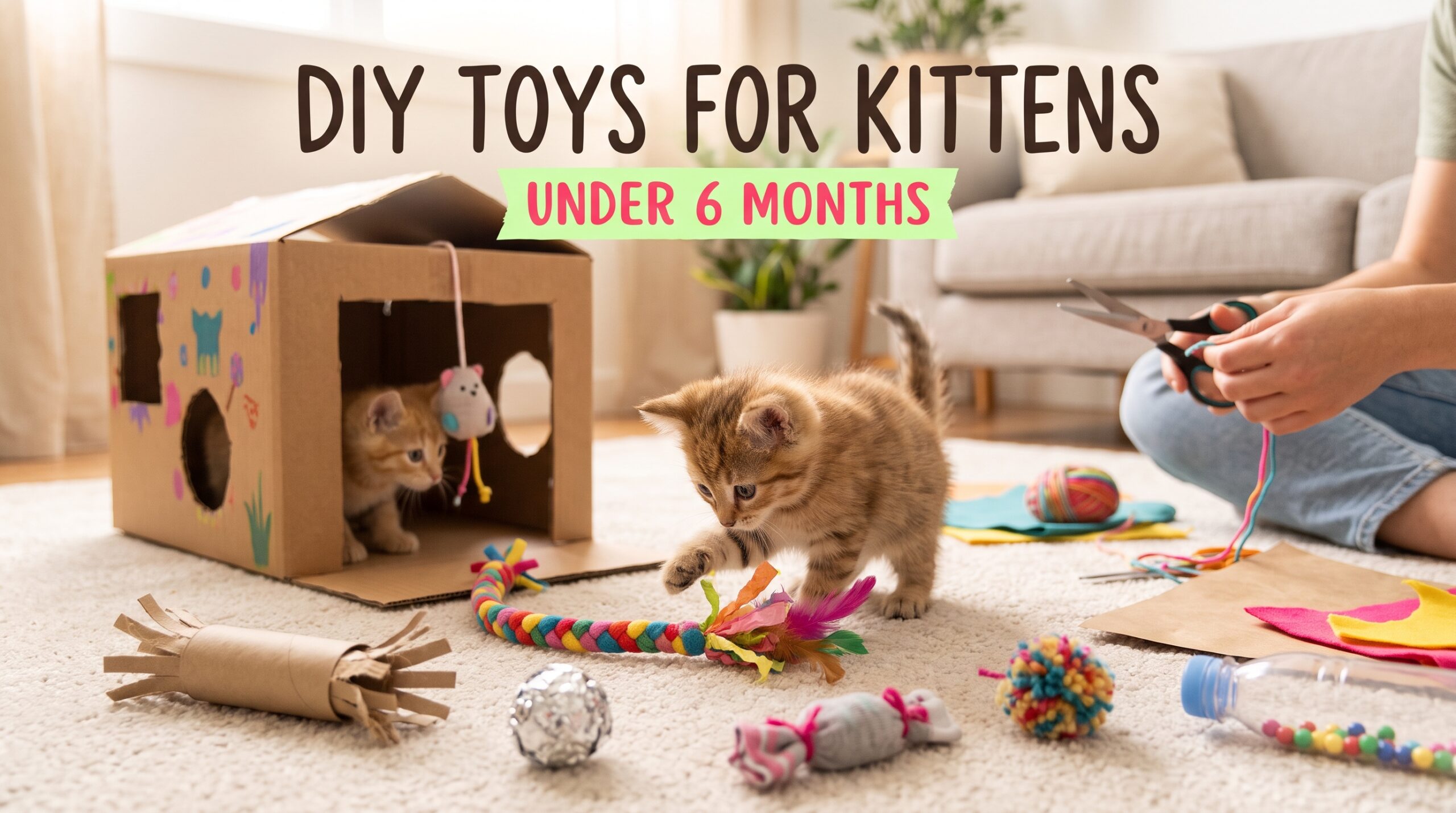
DIY toys for kittens under 6 months use four safe materials: uncoated cardboard, plain cotton fabric, paper tubes, and unscented paper. Each toy takes under 10 minutes to build and costs under $2. Every toy follows 3 rules: no string, no glue, and no part smaller than a quarter.
A kitten without an outlet for the stalk-chase-pounce sequence redirects it onto ankles, curtains, and charging cables. Environmental enrichment starts with that outlet. This guide gives 7 step-by-step builds of easy kitten toys and homemade kitten toys, a material safety table, and an age-by-age toy chart.
What You Need: Cheap Enrichment Toys From Household Items
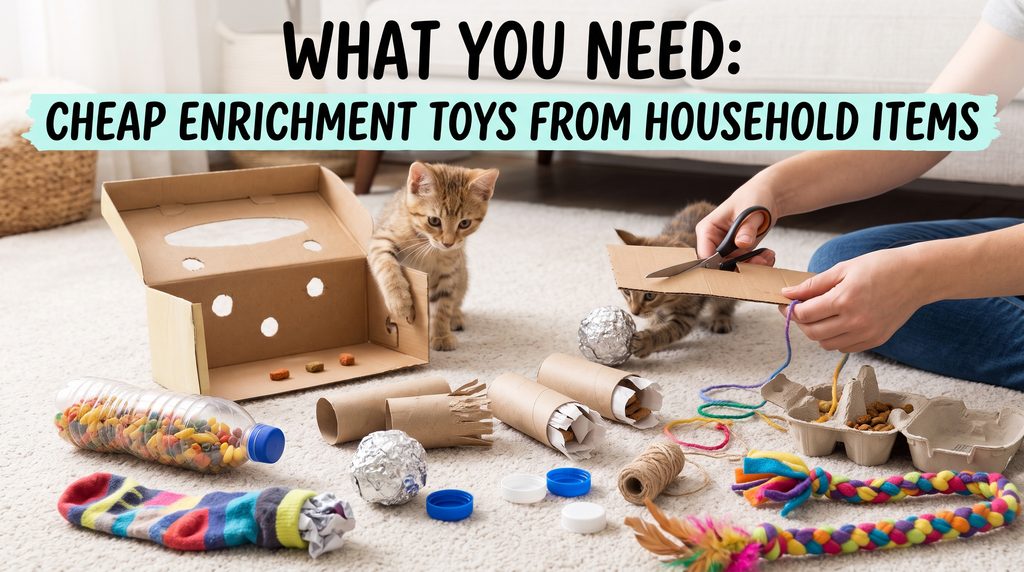
Cheap enrichment toys for kittens cost $0 to $5 for all 7 builds. Kitten toys from household items need prep first: remove all tape and staples from every box, and wash the sock and washcloth. Cheap DIY cat toys like these answer how to make kitten toys with materials already in the house, and kitten-proofing your home comes first, so the Kitten-Proofing Your Home: Room-by-Room Checklist walks through every room.
| Toy | Cost |
| Cardboard box | $0 |
| Puzzle feeder | $0 |
| Sock crinkle | $0 to $1 |
| Cat tunnel | $0 to $0.50 |
| Teething washcloth | $1 |
| Wand toy | $2 |
| Catnip sock | $0.25 plus 1 sock |
Kitten Toy Safety: What Can Kittens Play With Safely?
Safe kitten toys use uncoated cardboard, paper tubes, plain cotton, and unscented paper. These rules apply to kittens aged 8 weeks to 6 months, whose smaller airways and intestines raise obstruction risk compared with adults. What toys are safe depends on size and construction, and DIY cat toys pass only when they clear the 3-point check: no loose parts under 1 inch, no string or ribbon, and no glue or toxic ink.
Linear foreign body is the main string risk. Swallowed string, yarn, or ribbon can anchor under the tongue or in the stomach and cut through intestinal tissue, and the ASPCA lists string as a hazard. Parts under 1 inch are choking hazards.
Supervised kitten play is the rule for every fabric, paper, or dangling toy. The toy comes out during an active session, then goes back into a closed container. See Toxic Plants and Household Items for Kittens for hazards outside the toy box.
Safety note: discard any toy that frays, tears, or sheds a part.
| Safe materials | Unsafe materials | Reason |
| Cotton jersey strip | String, yarn, ribbon | Linear foreign body |
| Uncoated corrugated cardboard | Glossy or waxed boxes | Coatings and inks |
| Paper tubes | Plastic bags | Chewed plastic is swallowed, and handles trap heads |
| Plain cotton sock | Toy stuffing | Loose fill is swallowed in clumps |
| Sanded wooden dowel | Rubber bands, hair ties | Elastic loops are swallowed whole |
| Plain, unscented paper | Glue-based craft materials | Adhesives and toxic ink |
Kitten Enrichment Ideas: 7 DIY Toys for Kittens You Can Make in Under 10 Minutes
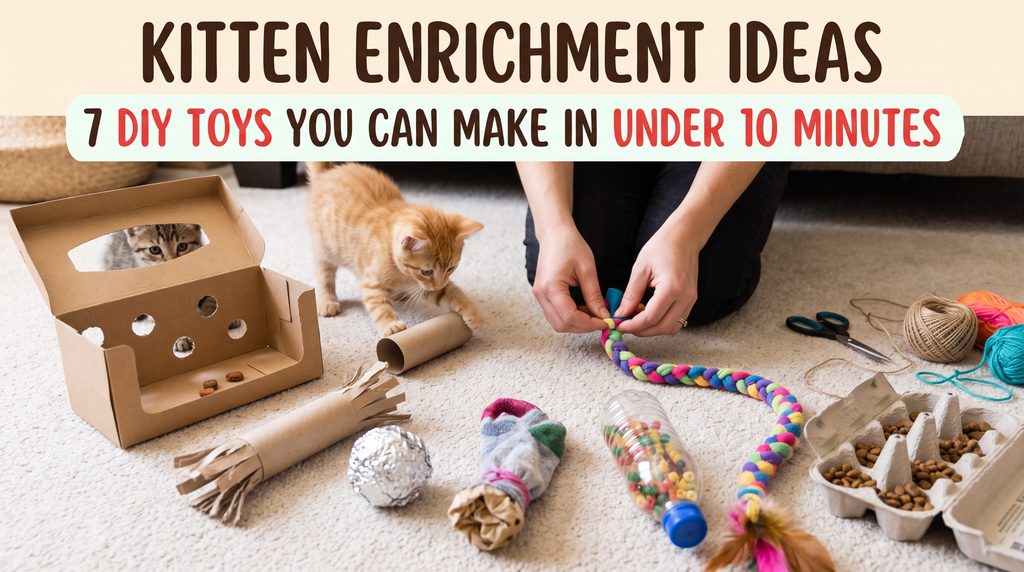
Each toy maps to one stage of the predatory sequence (stalk, chase, pounce, bite) and channels predatory play behavior into a hunting instinct outlet.
Cardboard Box Toys
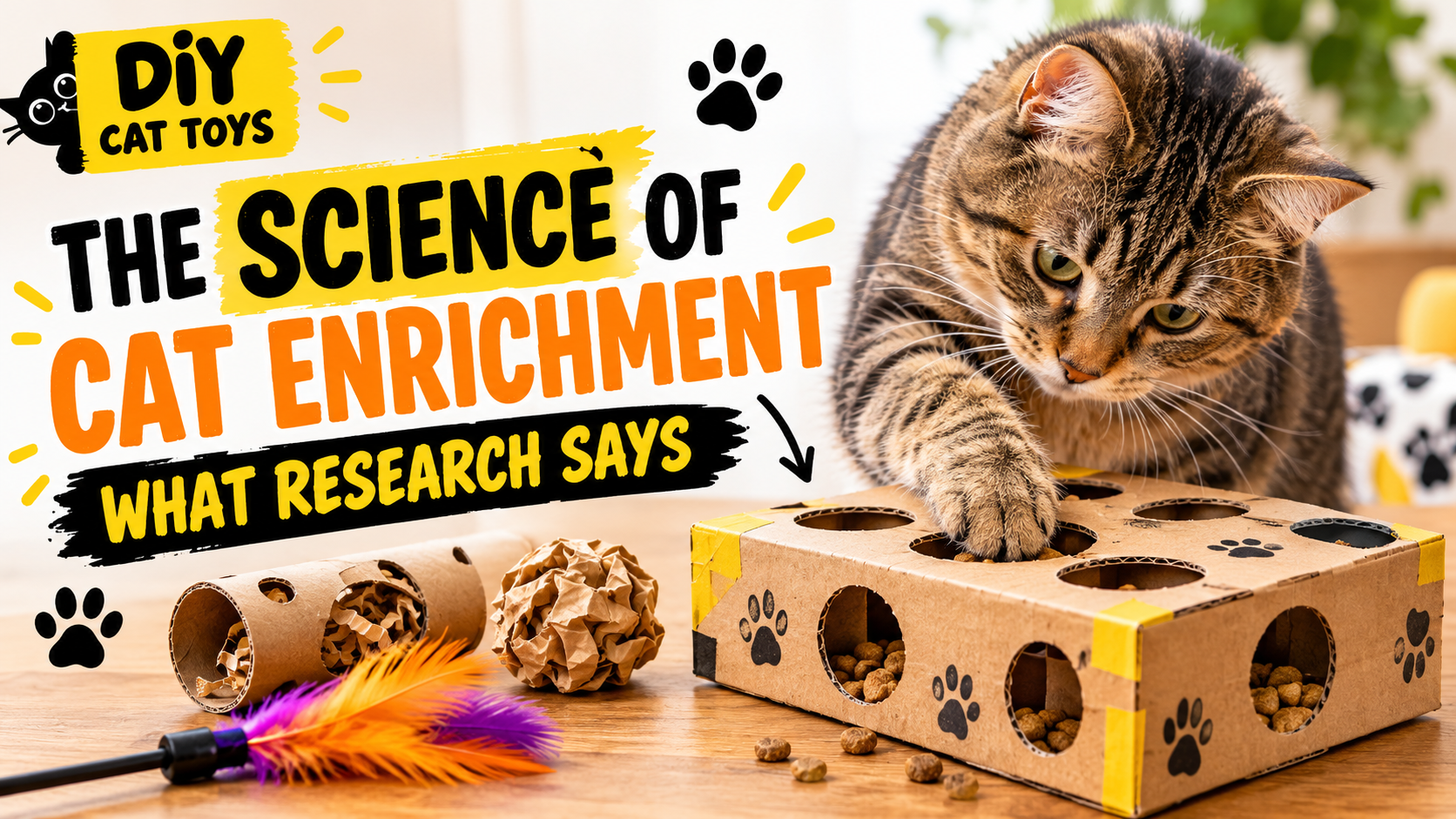
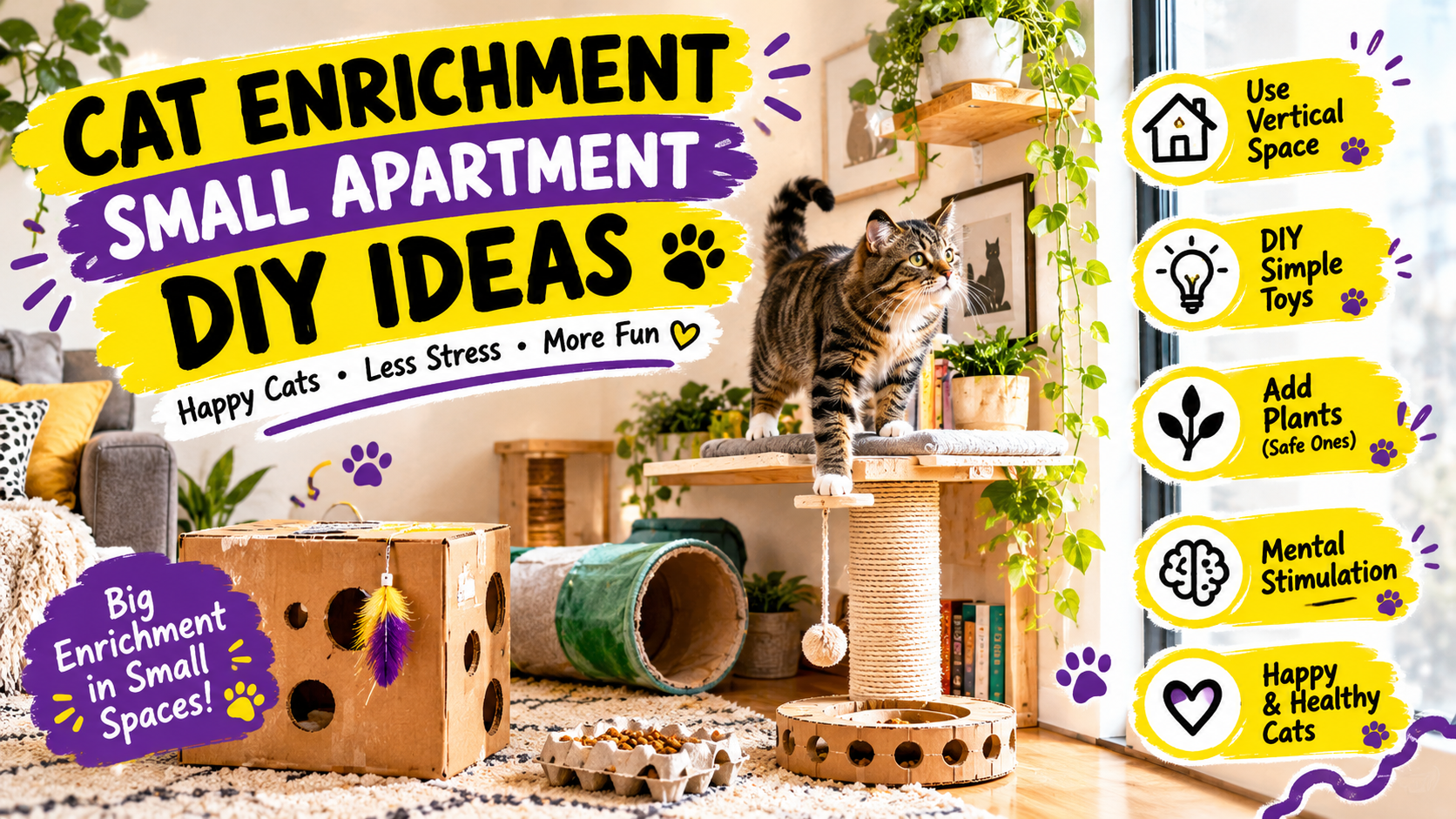
Cardboard box toys cover the stalk and pounce stages, and cardboard toys for kittens start with a 12 x 10 x 8 in uncoated box.
- Remove all tape and staples.
- Cut 3 holes, 3 inches in diameter each, into the sides with safety scissors, cutting away from your hand.
- Tape the lid closed with tape on the outside only, so no tape is exposed inside.
Safety flag: discard the box when the kitten chews through a wall.
DIY Puzzle Feeder (Kitten Foraging Games)
This DIY puzzle feeder turns kitten foraging games into a build with 6 toilet paper rolls and a shoebox.
- Stand 6 toilet paper rolls upright in a shoebox.
- Drop 5 kibble pieces from the kitten’s daily ration into each of 3 rolls.
- Set the box on the floor and let the kitten paw the kibble out.
[Kitten name, age in weeks] worked the 6-roll feeder for [X] minutes on the first try and cleared [X] of 15 kibble pieces. The first version used 4-inch tall rolls, and the kitten flattened them in [X] minutes, so version two uses a shoebox base. Foraging at this level suits a DIY puzzle feeder for young kittens, and slow feeder bowls are the next step up.
Safety flag: discard the rolls once they flatten or get damp.
Sock Crinkle Toys (No Sewing)
Sock crinkle toys are kitten toys with no sewing needs, and they cover the chase and bite stages.
- Crumple 2 sheets of plain, unprinted packing paper.
- Push the paper into the toe of a clean cotton sock.
- Tie a double knot 1 inch above the paper.
Safety flag: discard when the knot loosens or the sock tears.
DIY Cat Tunnel
A DIY cat tunnel covers the stalk and chase stages, and how to make a kitten tunnel takes 3 steps with a paper grocery bag.
- Cut the handles off the bag.
- Cut the base off to leave an open tube.
- Open both ends and lay the tube on its side.
Safety flag: never use plastic bags.
Kitten Teething Toys
Kitten teething toys cover the bite stage. Permanent teeth erupt between about 3 and 6 months, replacing deciduous dentition, so this toy fits that window among easy homemade toys for teething kittens.
- Wet a cotton washcloth.
- Twist it into a rope.
- Freeze it for 2 hours.
Safety flag: discard when threads fray, and offer it only during supervised sessions.
DIY Wand Toy With a Safe String Alternative
How to make a cat wand toy takes 3 steps and covers stalk, chase, and pounce. Cotton jersey strips work as safe string alternatives for kitten toys because jersey does not fray into threads.
- Cut an 8-inch strip, 1 inch wide, from an old cotton T-shirt.
- Tie the strip to the end of a 24-inch sanded dowel, 3/8 inch thick.
- Run a hand along the dowel to check for splinters.
Safety flag: store the wand in a closed cabinet after every session. Wand play anchors interactive play sessions.
DIY Catnip Toys (Age Caveat)
DIY catnip toys carry an age caveat: catnip response is hereditary and tends to appear after about 3 to 6 months, so kittens under 3 months often ignore it.
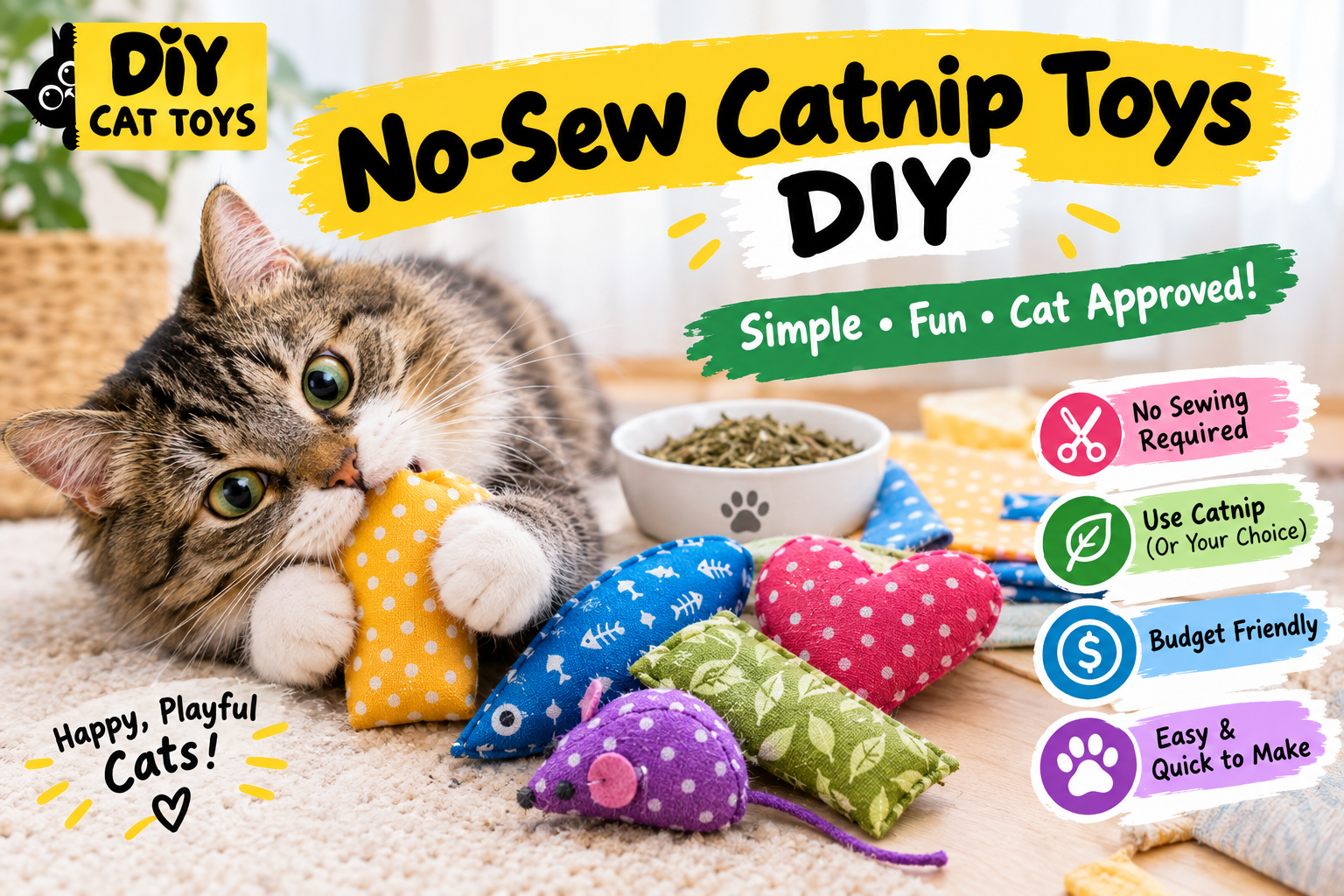
- Spoon 1 tsp dried catnip into the toe of a clean cotton sock.
- Tie a double knot 1 inch above the catnip.
Safety flag: catnip is non-toxic, but large ingested amounts cause mild stomach upset. Discard when the knot loosens.
Store-bought options appear in Best Store-Bought Interactive Toys for Kittens.
Best Homemade Toys for 8-Week-Old to 6-Month-Old Kittens (Age-by-Age)
DIY kitten toys follow 3 stages between 8 weeks and 6 months, and the best homemade toys for 8-week-old kittens are the box, the crinkle sock, and the tunnel. Homemade toys for kittens add complexity as coordination develops, and kitten play ideas shift with each stage. The Kitten Growth Stages: Week-by-Week Guide maps kitten developmental stages in more detail.
| Age range | Developmental focus | Best toys | Skip |
| 8 to 12 weeks | Exploratory play, inside the socialization window | Cardboard box toys, crinkle sock, tunnel | Puzzle feeders, wand, catnip |
| 12 to 16 weeks | Permanent teeth begin to erupt | Add puzzle feeders, wand play, frozen washcloths | Catnip socks |
| 16 weeks to 6 months | Chase and pounce coordination peaks | Add catnip socks, multi-roll feeders | Unsupervised fabric toys |
Kitten Boredom Busters: 4 Myths That Make DIY Toys Fail
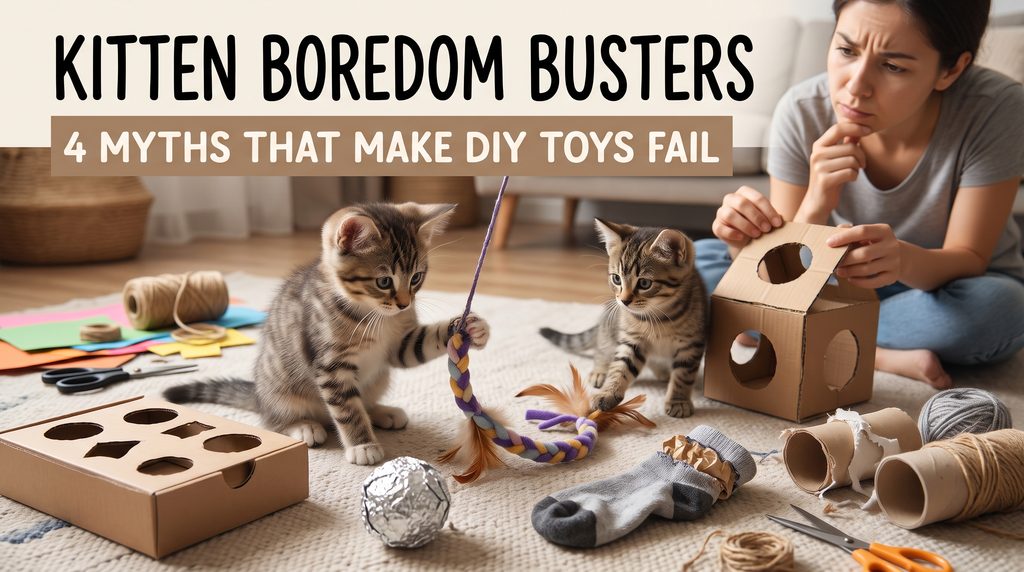
4 myths make DIY toys for bored kittens fail, and each has a direct fix. Knowing how to entertain kittens starts with correcting them, and how to make toys for kittens that last starts with the right materials.
- Myth: Yarn is a classic kitten toy. Fact: Yarn is a linear foreign body risk.
- Myth: Any cardboard works. Fact: Glossy or waxed boxes carry coatings, so only uncoated corrugated cardboard is used.
- Myth: One favorite toy is enough. Fact: Toys left out lose novelty, so a 3-toy daily rotation works.
- Myth: Catnip works on all kittens. Fact: Response typically begins after 3 months.
Fresh toys redirect energy that otherwise goes into furniture. See How to Stop a Kitten From Scratching Furniture to prevent destructive scratching.
How Much Playtime Do Kittens Need?
Kittens under 6 months need 3 play sessions per day, 10 to 15 minutes each, ending with a food reward to complete the hunt cycle. Confirm the schedule with the kitten’s veterinarian. The AAFP/ISFM Feline Environmental Needs Guidelines (Ellis et al., 2013) recommend regular play sessions and food puzzles as core environmental enrichment, and the guideline supports rotating toys to maintain novelty. Indoor cat enrichment and enrichment for indoor kittens rest on that pairing, and DIY enrichment toys for kittens deliver it cheaply.
Rotation: 3 toys out, 4 stored, swapped every 2 days. Wand play with the owner builds association with positive interaction, which supports bonding with your kitten and answers how to keep a kitten entertained between meals. Supervised kitten play applies to every session.
- Session 1, morning: 10 to 15 minutes of wand play, then a meal portion.
- Session 2, afternoon: 10 to 15 minutes with the puzzle feeder or box toys, ending with kibble.
- Session 3, evening: 10 to 15 minutes of interactive play sessions, ending with a food reward.
Safety note: stop sessions at the first sign of panting or overstimulation. The Kitten Feeding Schedule by Age lines up meals with play.
Frequently Asked Questions About DIY Toys for Kittens
What household items are safe for kittens to play with?
Safe household items for kittens are uncoated cardboard, paper tubes, plain cotton fabric, and unscented paper. Each material has no loose parts under 1 inch when built as shown in this guide. String, yarn, ribbon, and plastic bags are excluded for kittens under 6 months because they carry linear foreign body and suffocation risks.
Are cardboard boxes safe for kittens?
Uncoated cardboard boxes are safe for kittens when the original tape and staples are removed. Glossy or waxed boxes carry coatings, so only plain corrugated cardboard qualifies. Discard the box once the kitten chews through a wall or the edges fray, because swallowed cardboard pieces add obstruction risk.
How much playtime do kittens need?
Kittens under 6 months need 3 play sessions daily, 10 to 15 minutes each, with a food reward at the end. The reward completes the hunt cycle after the stalk, chase, pounce, and bite. Confirm the schedule with the kitten’s veterinarian, since energy levels differ by age and health.
When can kittens start playing with toys?
Kittens start playing with toys from about 3 to 4 weeks old, using simple, large, soft items. Weaned kittens at 8 weeks use the toys in this guide, matched to the age chart above. Kittens under 8 weeks need a veterinarian’s input on toy choice.
How do you make a kitten tunnel at home?
Make a kitten tunnel from 1 paper grocery bag by cutting off the handles and the base, then opening both ends. The result is an open tube with 2 exits. Plastic bags are excluded because chewed plastic is swallowed and handles trap heads.
Conclusion
A kitten under 6 months needs 3 play sessions daily, and uncoated cardboard, plain cotton, and paper tubes cover every toy in that routine safely.
A daily outlet for the predatory sequence reduces destructive redirection onto ankles, curtains, and charging cables, and wand play builds the owner bond. The kitten toys you can make at home start tonight with the cardboard box toy, which takes under 10 minutes. Fabric, paper, and wand toys go back into a closed container after every session.
Subscribe for the next guide: a room-by-room kitten-proofing checklist you can print.