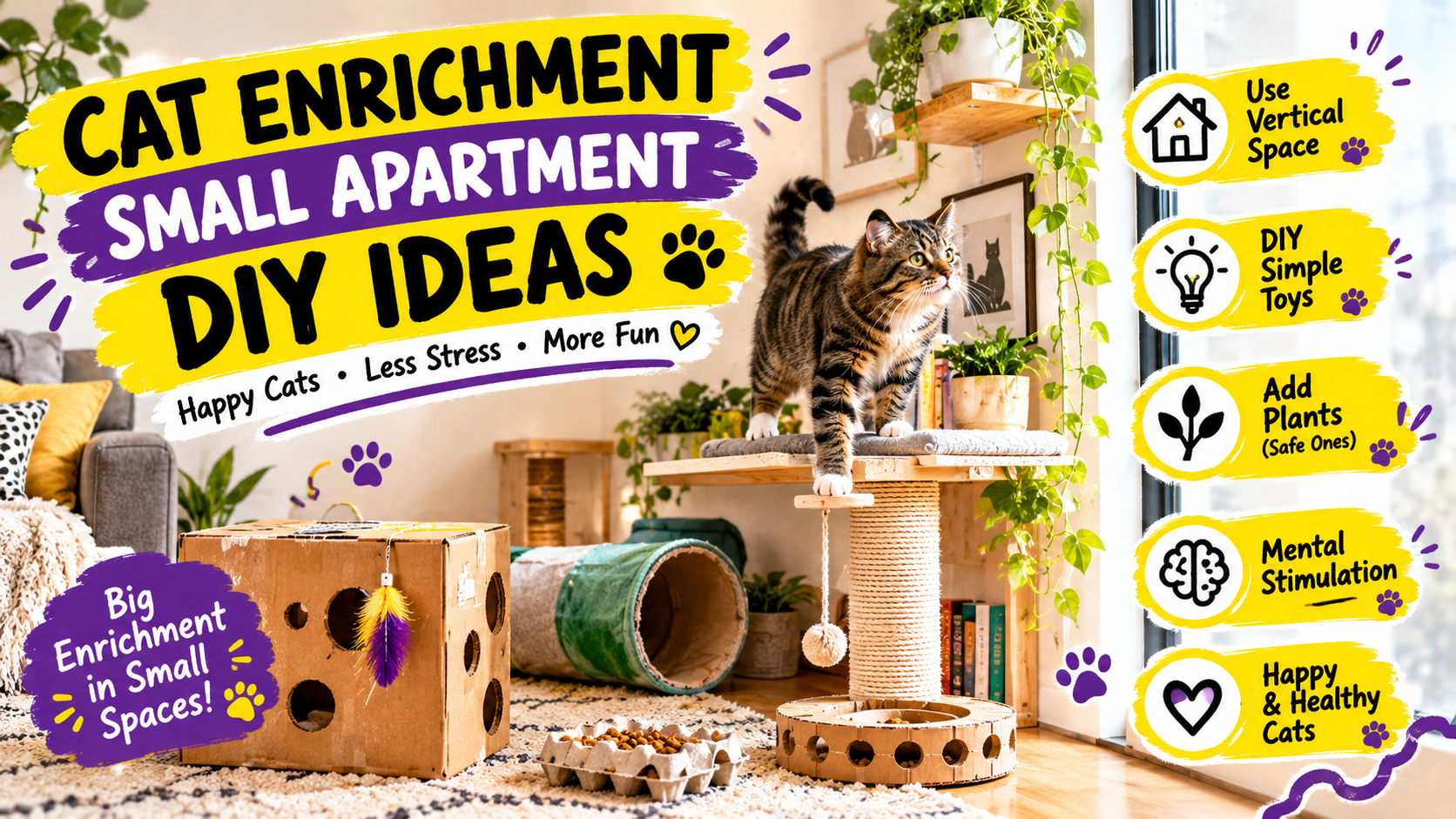
Cat enrichment in a small apartment requires 3 changes: vertical space, puzzle-based meals, and 2 predatory play sessions of 10 minutes each per day. These DIY cat enrichment ideas cover all 3, and 8 of the 11 builds use cardboard, paper, or household items and cost $4 or less. Kittens under 12 months and cats over 10 years need the modified versions flagged in each section.
A small space cat in 500 square feet has one floor plane and no outdoor access, so boredom surfaces as 3 AM zoomies, shredded sofa corners, and overgrooming. This list gives you 11 builds with materials, build times, and costs, and the first indoor cat enrichment project takes 5 minutes.
What Is Indoor Cat Enrichment, and What Are the Signs Your Cat Needs It?
Indoor cat enrichment means environmental enrichment: modifying a cat’s surroundings so the cat performs species-typical behaviors, including climbing, scratching, hunting, hiding, and scent exploration. Learning how to enrich a cat’s environment also supplies the cat mental stimulation that a food bowl and a sofa cannot. The AAFP and ISFM Environmental Needs Guidelines (Ellis et al., Journal of Feline Medicine and Surgery, 2013) [LINK] define 5 pillars: a safe place, multiple separated key resources, opportunity for play and predatory behavior, positive human-cat interaction, and an environment that respects the cat’s sense of smell, the basis of olfactory enrichment.
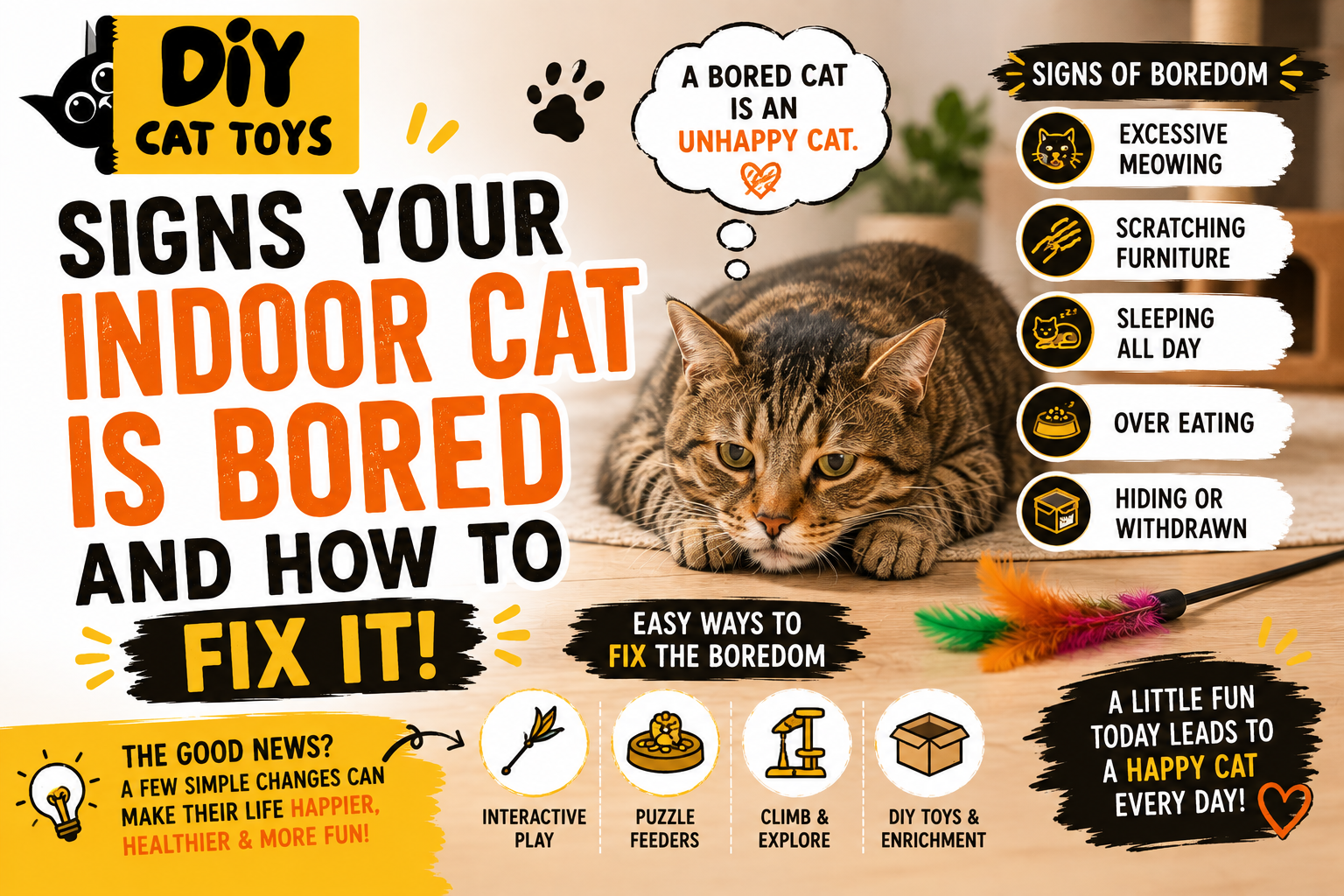
How to enrich indoor cats comes down to completing the predatory sequence: stalk, chase, pounce, bite, eat. Environmental enrichment for cats that stops at the chase leaves the sequence unfinished, and natural cat instincts then redirect onto furniture and ankles. Cat boredom signs include:
- Nighttime vocalizing
- Overgrooming
- Scratching non-scratcher surfaces
- Attacking ankles
Overgrooming and vocalizing overlap with medical conditions, so a veterinary exam comes before a boredom diagnosis. Persistent cat behavior problems are covered in Cat Behavior Problems: Causes and Fixes.
How Do You Create Vertical Space for Cats in a Small Apartment Without Drilling?
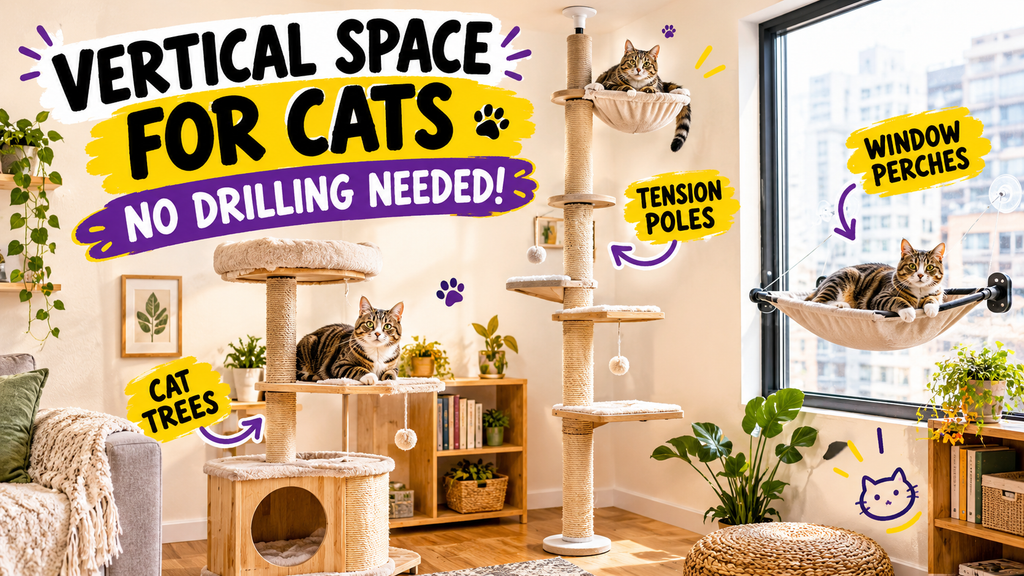
Vertical cat space expands a cat’s usable territory without adding floor area, which matters in a studio under 500 square feet. A small apartment cat setup with 3 elevated levels turns one floor plane into 4 layers of core territory. Vertical space for cats also doubles as a retreat in multi-cat households, where 2 cats need 2 separate perches.
Step spacing runs 12 inches for kittens under 12 months and cats over 10 years, and 18 inches for healthy adults. Every platform holds 2 times the cat’s weight, and cats over 14 pounds need platforms rated to 30 pounds. Kittens under 12 months, cats over 10 years, and cats with arthritis need ramps with 6-inch rises. Load-test every build with a 30-pound weight before the cat uses it.
Tension poles, furniture-top platforms, and window-frame tension rods are renter-friendly cat solutions with 0 holes. A DIY cat climbing wall for apartments requires drilling into studs, so it is a landlord-approval build only. See Best Cat Trees for Small Apartments for store-bought options. Prices below vary by retailer and region.
1. DIY Cat Shelves: Bookshelf-Top Platform
Cat shelves for apartments start on top of an existing bookshelf, which leaves the wall intact. Glue a felt or carpet remnant to the board with non-toxic adhesive, set the board on the bookshelf, and load-test it. This build suits healthy adults, while seniors and kittens reach it by a 6-inch-rise ramp.
Spec: 1 board (12 x 24 inches), felt or carpet remnant, non-toxic adhesive | 20 minutes | $15
2. DIY Cat Tree: Tension-Pole Tower
A DIY cat tree built on a floor-to-ceiling tension pole needs 0 drilled holes. Fasten 2 plywood platforms to the pole, wrap the pole in sisal rope for scratching, and push the top: 0 inches of lateral movement passes the wobble test. A tower that shifts under a jump is a fall hazard in multi-cat homes, so test it before use.
Spec: tension pole, 2 plywood platforms, sisal rope | 90 minutes | $45
3. DIY Cat Window Perch
A DIY cat window perch spans the window frame on a tension rod and holds 1 board. Window perches expose cats to feline high-rise syndrome, so every screen must be intact and latched before the cat sits there. Cat window perch builds suit window watchers of every age.
Spec: tension rod, 1 board (10 x 20 inches) | 25 minutes | $20
Which DIY Puzzle Feeders and Foraging Toys Work in a Small Apartment?
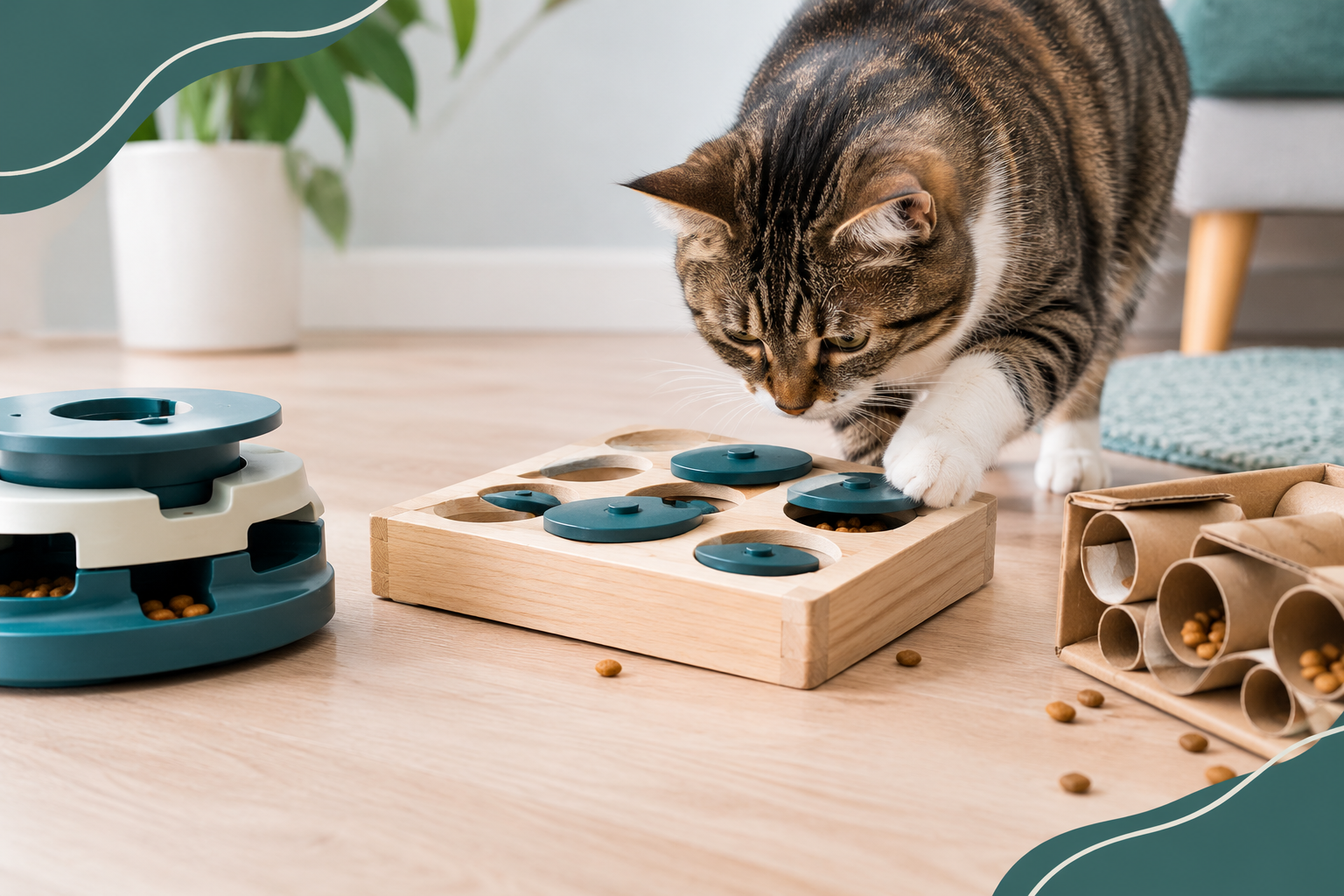
Foraging replaces bowl feeding with a hunt, and interactive feeding methods slow eating while adding exercise, which supports cat exercise and obesity prevention. Every puzzle meal comes out of the daily food allowance, so calories stay constant. Cats with diabetes or kidney disease follow a veterinarian-set feeding schedule, so their feeders hold only prescribed portions. The Ohio State University Indoor Pet Initiative lists food puzzles among its indoor cat enrichment tools.
DIY Puzzle Feeder (Items 4 and 5)
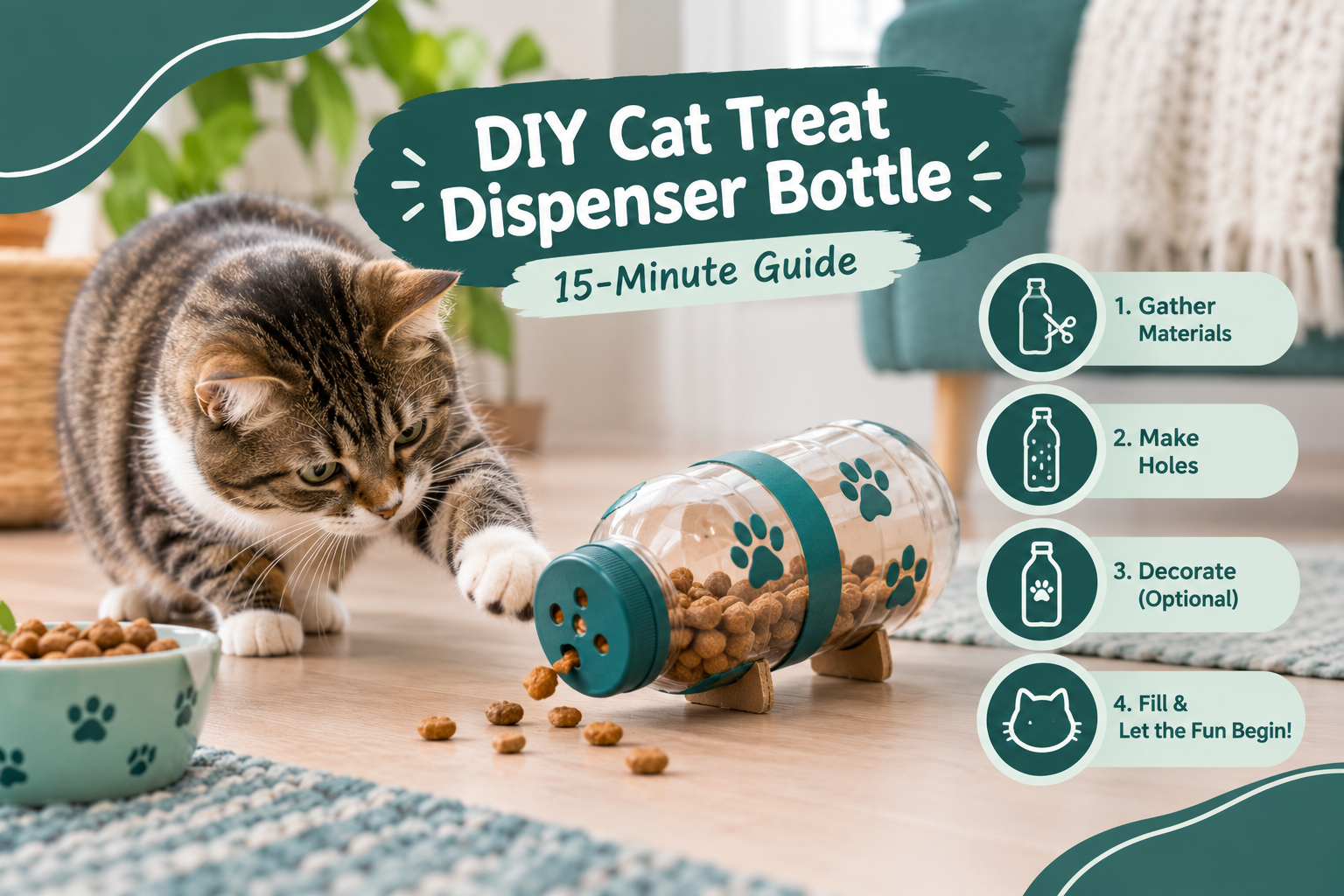
A DIY puzzle feeder is the fastest answer to how to make cat puzzle feeders: cut, fill, introduce. A DIY cat puzzle feeder built from cardboard also counts as one of the cat toys from cardboard that cost $0. Discard cardboard feeders after 2 uses with wet food, and cut all hole edges smooth.
4. Toilet-Paper-Roll Feeder. Cut 3/4-inch holes in 6 toilet paper rolls, stand the rolls upright in a box, and drop 20 kibbles inside. Start with 4 open holes per roll, then tape 2 shut as the cat improves. On first use, leave the kibbles visible through the holes so the cat links the toy to food.
Spec: 6 rolls, 1 box, tape | 5 minutes | $0
[CAT AGE AND BREED] needed [X] days to clear the 6-roll feeder, and the first attempt took [X] minutes for 20 kibbles. [CAT NAME] first [OBSERVED ACTION, e.g., tipped the box or fished with a paw], and by day [X] the same 20 kibbles took [X] minutes.
5. Cardboard Box Maze. Cardboard box ideas for small spaces peak with a maze: link 4 boxes through 3-inch entry holes and scatter 10 kibbles across them. Kittens and play-driven cats explore the maze for longer than a flat bowl holds their attention.
Spec: 4 boxes, scissors | 15 minutes | $0
Homemade Cat Foraging Toys (Item 6)
6. Muffin-Tin Foraging Toy. Homemade cat foraging toys include the 12-cup muffin tin: hide kibble under 12 ping-pong balls, 1 per cup, and the cat paws each ball out. Scatter-feeding the same meal in 3 rooms adds walking to the hunt. These cat foraging toys and the 2 builds above are cheap DIY toys for indoor cats at $0 to $4 each, and fast eaters gain the most. Portion guidance lives in Best Wet Food Portion Sizes by Cat Weight.
Spec: 12-cup muffin tin, 12 ping-pong balls | 5 minutes | $0 to $4
What Homemade Cat Toys and Hunting Games Satisfy Predatory Behavior?
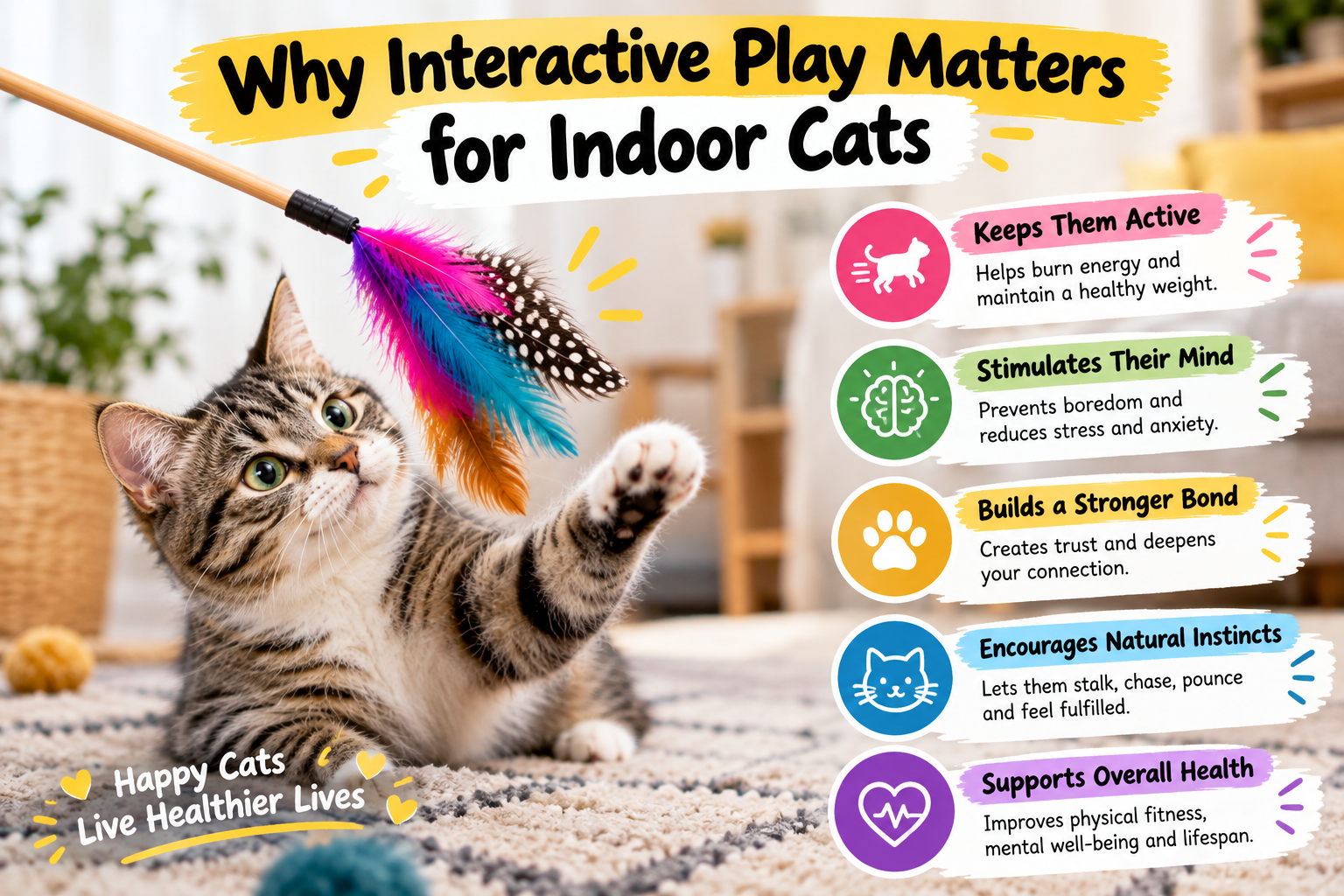
Homemade cat toys supply the predatory behavior outlet that apartments lack. Cat hunting games run 2 sessions of 10 minutes daily and end with a catch plus a meal. Multi-cat homes run 1 wand session per cat, with separate feeders. These cat toys DIY builds use 3 materials: cardboard, paper, and cord.
Cat Hunting Games and Post-Play Outlets (Items 7 to 10)
Simple DIY cat games for indoors follow the predatory sequence: stalk, chase, pounce, catch. Apartment cat play ideas below fit in 0 to 1 square foot, and each qualifies as one of the easy homemade cat toys at home.
- Wand Toy. Drag the feather along the floor and behind furniture so the cat stalks, then let the cat catch it at the end. String and yarn cause linear foreign body obstruction, so the wand goes out of reach after every session. See Best Interactive Wand Toys for Indoor Cats. Spec: 36-inch dowel, 36-inch cord, feather | 10 minutes | $4
- Paper Ball Chase. Crumple 6 sheets into 3-inch balls and roll them across the floor for solo chase. Spec: 6 sheets of paper | 2 minutes | $0
- Cardboard Scratcher. Cat scratching ideas that protect sofa corners start with corrugated cardboard: glue 20 layers into a 12 x 4 inch block, using non-toxic white glue only, and cure it per the glue label. Spec: 20 layers of corrugated cardboard, non-toxic white glue | 20 minutes | $3
- Cat Grass Pot. Cat-safe grass in a 6-inch pot adds olfactory enrichment and a chewing outlet. Skip essential oils, and keep lilies out of the apartment, since the ASPCA Animal Poison Control Center lists lilies as toxic to cats. Spec: cat-safe grass seed, 6-inch pot | 10 minutes | $4
Rotating Cat Toys (Item 11)
- Rotation System. Rotating cat toys keeps novelty high: 3 toys stay active for 7 days while the other 3 sets wait in an opaque bin, 4 sets total. Swap the active set every 7 days. Spec: 1 opaque bin | 10 minutes | $0
Does a Window and 3 Toys Give an Apartment Cat Enough Enrichment? (Myths and Mistakes)
Myth 1: Cats sleep 12 to 16 hours, so boredom is minor. Fact: the 8 waking hours need structured outlets. What to do with bored cats starts with filling those hours with 2 play sessions and 1 puzzle meal.
Myth 2: More toys equal more enrichment. Fact: cats engage more with a rotated toy than with 20 toys left on the floor, because novelty drives engagement. These indoor cat boredom busters work on rotation, not volume.
Myth 3: A second cat fixes boredom. Fact: an incompatible pair raises stress, and stress relief for indoor cats depends on compatibility, so test with a gradual introduction first. Natural cat instincts include territorial defense. See Should You Get a Second Cat? Compatibility Guide.
Mistake: laser pointer sessions with no physical catch. The cat never completes the sequence, and frustration follows. End every session with a treat or toy, and never aim a laser at a cat’s eyes.
How Much Does DIY Cat Enrichment Cost and How Long Does Each Build Take?
Budget cat enrichment ranks all 11 builds by cost and time. Cheap indoor cat activities start at $0 and 5 minutes, and 4 of the 11 builds are no-cost cat enrichment ideas at home. The best cat enrichment for apartments stays under 4 square feet per build, which makes these cat enrichment ideas for tiny spaces and cat enrichment for apartments practical. The recommended first build is the toilet-paper-roll feeder.
| Project | Cost | Build Time | Footprint | Best For |
| Toilet-roll feeder | $0 | 5 min | 1 sq ft | All ages |
| Muffin-tin foraging | $0 to $4 | 5 min | 1 sq ft | Fast eaters |
| Cardboard maze | $0 | 15 min | 4 sq ft | Kittens, play |
| Wand toy | $4 | 10 min | 0 | Hunting outlet |
| Paper ball chase | $0 | 2 min | 0 | Solo play |
| Cardboard scratcher | $3 | 20 min | 1 sq ft | Furniture protection |
| Cat grass pot | $4 | 10 min | 1 sq ft | Scent enrichment |
| Rotation system | $0 | 10 min | 1 bin | Multi-toy homes |
| Bookshelf platform | $15 | 20 min | 0 (on shelf) | Healthy adults |
| Window perch | $20 | 25 min | 2 sq ft | Window watchers |
| Tension-pole tree | $45 | 90 min | 3 sq ft | Climbers, multi-cat |
Prices vary by retailer and region. Shopping for the rest of the setup is covered in Cat Supplies Checklist for First-Time Apartment Owners.
Frequently Asked Questions About DIY Cat Enrichment in Small Apartments
How to Keep Indoor Cats Entertained in a Small Apartment?
How to entertain cats in a small apartment comes down to 3 daily components: vertical access (a bookshelf-top platform), 1 puzzle meal (a 6-roll toilet-paper feeder), and 2 predatory play sessions of 10 minutes each (a wand toy with a catch at the end). Together, these replace the climbing, hunting, and foraging an indoor cat lacks.
What Can I Make for My Cat With Household Items?
What you can make for your cat with household items: a toilet-roll feeder (6 cardboard rolls, 5 minutes), a paper ball chase (6 crumpled 3-inch balls, 2 minutes), and a cardboard scratcher (20 layers of corrugated cardboard plus non-toxic glue, 20 minutes). These cat enrichment ideas with household items cost $0 to $3 each.
How to Stop Cat Boredom Indoors?
Stopping cat boredom indoors takes 3 changes: rotate 3 toys every week, add 1 vertical perch, and replace 1 bowl meal daily with a puzzle meal. Persistent overgrooming, nighttime vocalizing, or appetite changes after these changes call for a veterinary exam to rule out medical causes.
How Often Do You Rotate Cat Toys?
Rotating cat toys every 7 days keeps 3 toys active while the other sets stay out of sight in an opaque bin. Cats show more interest in a toy that returns after a 3-week absence, and that novelty is the reason the swap works.
Are DIY Cat Toys Safe?
DIY cat toys are safe when they use non-toxic glue, smooth-cut cardboard, and no unsupervised string. Linear foreign body obstruction from string and yarn is the main hazard in cats of all ages, so cat-safe materials and wand storage after every session are mandatory.
The Daily Routine That Makes a Small Apartment Enough
A small apartment gives a cat enough enrichment when 3 components run daily: vertical access, a foraged meal, and 2 predatory play sessions of 10 minutes each.
A cat with those 3 components uses climbing, hunting, and feeding outlets that otherwise land on sofa corners and ankles. The toilet-roll feeder (5 minutes, $0) starts the routine, the bookshelf platform adds height for $15, and the 7-day toy rotation keeps every build in use without new purchases. Cats over 10 years, cats with arthritis, and kittens under 12 months run the modified versions flagged above.
These apartment cat tips work in 500 square feet because no build exceeds 4 square feet of floor space. Tell us which build your cat attacked first in the comments, and include your cat’s age and your apartment size.